
Pilates for Sports Injury Recovery: How It Can Support a Safe Return to Activity
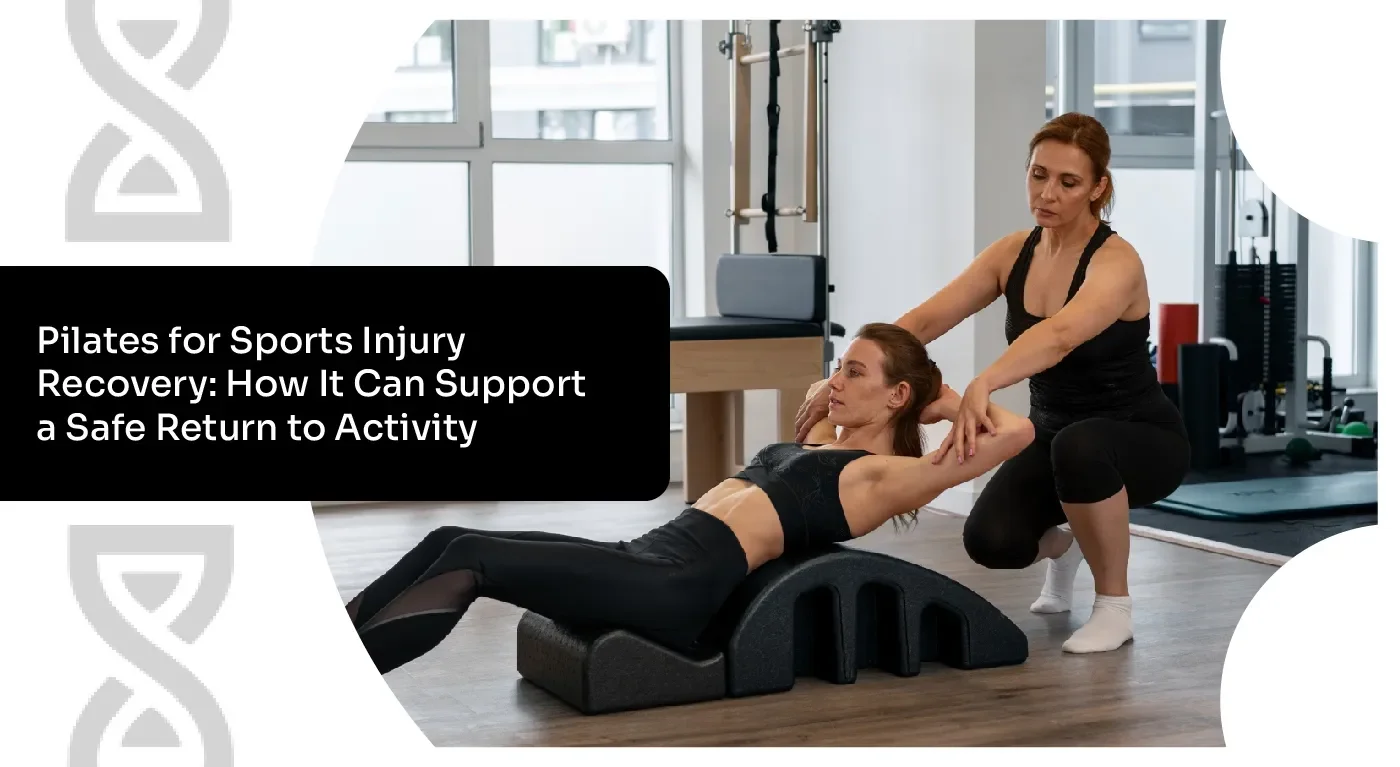
Returning to sport after an injury involves more than waiting for pain to settle.
An athlete may feel ready to exercise again but still have reduced strength, mobility, balance or confidence. These limitations can become more noticeable when the body is placed under the demands of running, jumping, changing direction or repeated movement.
Rehabilitation therefore needs to bridge the gap between basic recovery and the demands of the sport itself.
For some athletes, Pilates for Sports Injury Recovery can be incorporated into a broader rehabilitation programme to develop movement control, strength, stability and physical confidence.
It should complement, rather than replace, appropriate assessment and sport-specific rehabilitation.
Why Returning to Sport Can Be Difficult
Sport places considerably higher demands on the body than many everyday activities.
Walking around the house may be comfortable, but running, jumping or rapidly changing direction requires significantly greater force and coordination.
An athlete returning from injury may therefore need to rebuild several physical qualities before returning to full training.
These can include:
Strength
Balance
Mobility
Coordination
Reaction
Stability
Endurance
Confidence
The exact requirements depend on the sport and the injury.
Also Read: Clinical Pilates for Athletes: Improve Performance Without Increasing Injury Risk
Why General Strength Isn't Always Enough
An athlete can regain general strength and still struggle with sport-specific movement.
For example, a footballer returning after a lower-limb injury needs to tolerate acceleration, deceleration and changes of direction.
A tennis player needs controlled rotation and rapid movement.
A runner needs to tolerate repetitive impact.
A swimmer may need adequate shoulder mobility and trunk control.
Rehabilitation therefore needs to gradually reflect the physical demands of the athlete's activity.
How Pilates Fits Into Sports Rehabilitation
Pilates can provide a controlled environment for developing foundational movement qualities.
Exercises can be adjusted according to the athlete's current ability and progressively made more challenging.
Depending on the individual, sessions may focus on:
Trunk stability
Hip control
Lower-limb strength
Shoulder stability
Balance
Mobility
Coordination
Controlled loading
This foundation can then complement sport-specific training.
The aim is not to turn Pilates into a replacement for an athlete's normal training programme.
Instead, it can address movement qualities that support the wider rehabilitation process.
Rebuilding Strength After an Injury
Injury and reduced activity can lead to strength loss.
The amount of weakness depends on the injury, the period of reduced activity and the structures involved.
Returning to previous training loads too quickly can be challenging because the body may not yet have regained its previous capacity.
Progressive resistance is therefore an important part of recovery.
Exercises can gradually increase in difficulty as the athlete develops greater strength and control.
This might involve changing:
Resistance
Repetitions
Range of movement
Speed
Stability requirements
Exercise complexity
Mobility and Stability Need to Work Together
Mobility and stability are often discussed separately, but sport requires both.
A joint needs enough movement to perform its role, while surrounding muscles need to provide appropriate control.
For example, an athlete may have sufficient hip mobility but poor control during single-leg movements.
Another athlete may have good strength but limited ankle mobility affecting their movement mechanics.
A personalised assessment can help identify which qualities require attention rather than assuming every athlete needs the same exercises.
Also Read: How to Return to Exercise After an Injury
Rebuilding Confidence After an Injury
Physical recovery does not always happen at the same rate as psychological recovery.
An athlete may be physically capable of performing a movement but still hesitate because they remember the pain or circumstances surrounding the original injury.
Gradual exposure can help rebuild confidence.
Starting with controlled movements and progressing towards more demanding tasks allows athletes to experience their improving capacity rather than immediately being placed under full sporting demands.
Returning to Sport Should Be Progressive
A return-to-sport programme should generally progress from simpler movements towards activities that more closely resemble the athlete's sport.
For a runner, this may eventually include progressive running.
For a footballer, it may involve acceleration, deceleration and directional changes.
For a tennis player, it may involve rotational and lateral movements.
The exact progression should be based on the injury, recovery stage and professional guidance.
There is no single exercise or timetable that applies to every athlete.
How Pilates Can Complement Physiotherapy
Physiotherapy and Pilates can work together, depending on the individual's needs.
A physiotherapist may assess an injury, establish a rehabilitation plan and determine appropriate milestones.
Pilates sessions can then provide a structured environment for practising movement control, strength and stability within that broader plan.
This is particularly useful when rehabilitation requires gradual progression rather than simply returning directly to normal training.
Communication between relevant professionals can help ensure the programme remains appropriate.
Injury Prevention Is More Than One Exercise
The term Injury Prevention Pilates can sometimes give the impression that a particular exercise can prevent an injury.
In reality, sports injuries are influenced by many factors.
These may include:
Training load
Recovery
Previous injuries
Strength
Mobility
Technique
Sleep
Sport-specific demands
Sudden changes in training
Pilates can contribute to physical preparation, but it should be viewed as one component of a broader training and recovery strategy.
When Should an Athlete Seek Professional Assessment?
Professional assessment is particularly important when an injury involves significant pain, swelling, weakness, instability or loss of function.
It is also worth seeking guidance when:
Symptoms keep returning
Performance has changed significantly
You are unsure when to return to sport
You are compensating for an injured area
Pain is increasing with training
You are recovering from surgery
Trying to train through an unresolved injury can make it more difficult to understand what the body is tolerating.
Also Read: Common Injuries That May Benefit From Clinical Pilates
Testimonials
What Does a Good Return-to-Sport Programme Look Like?
A good programme should be individualised and progressive.
It should consider where the athlete is now rather than where they were before the injury.
The programme may begin with basic control and gradually introduce:
Foundation → Strength → Stability → Dynamic Movement → Sport-Specific Demands → Full Training
Each stage should be progressed according to the athlete's response and relevant professional guidance.
The process may take longer for some injuries than others.
The objective is to rebuild capacity rather than simply reach a date on the calendar.
Frequently Asked Questions
Can Pilates help athletes recover from injuries?
Pilates can form part of a rehabilitation programme by developing strength, mobility, stability and movement control. Its suitability depends on the individual injury and recovery stage.
Is Pilates enough to return to sport?
Not necessarily. Athletes generally need sport-specific training as well as rehabilitation. Pilates can provide useful foundational conditioning within that broader programme.
Can Pilates help prevent sports injuries?
It may contribute to physical preparation by improving strength, control and movement quality, but no exercise programme can guarantee that an injury will not occur.
Should I do Pilates while seeing a physiotherapist?
It may be appropriate for some people. Ideally, the Pilates programme should complement the rehabilitation plan provided by the treating professional.
How soon can I return to sport?
There is no universal timeline. Return should depend on the injury, physical capacity, symptoms, sport-specific demands and appropriate professional guidance.
Supporting a Stronger Return to Sport
Recovering from a sports injury is a process of rebuilding capacity.
The goal is not simply to stop hurting. An athlete needs to regain the strength, mobility, control and confidence required for the activities they want to return to.
For suitable individuals, Pilates can provide a controlled and adaptable way to work on these qualities while progressing towards more demanding movement.
At Arena Clinical Pilates North Curl Curl, personalised sessions can complement an athlete's broader rehabilitation and conditioning programme. If you're considering Pilates for Injury Recovery Northern Beaches, the programme should be based on your current ability, injury history and goals rather than a generic exercise routine.